[Background]
Over the past few decades, transistor miniaturization has continuously improved chip performance, reduced energy consumption, and expanded its application range. With the acceleration of global digital transformation, there is an urgent demand for high-performance, low-power, and highly integrated chips. The development of emerging technologies such as 5G, AI, and the Internet of Things has brought new development opportunities to the chip design industry. Consumers’ increasing demand for performance and functionality in electronic products has driven the demand for high-performance semiconductor chips.
As a result, all sectors are investing in chip research and development.
[Pain Points]
With the increasing integration density and shrinking line widths of chips, measuring internal temperature distribution has become increasingly difficult. Traditional contact temperature measurement methods can damage the chip and are affected by factors such as the chip surface material and heat dissipation conditions, resulting in inaccurate temperature measurement results.
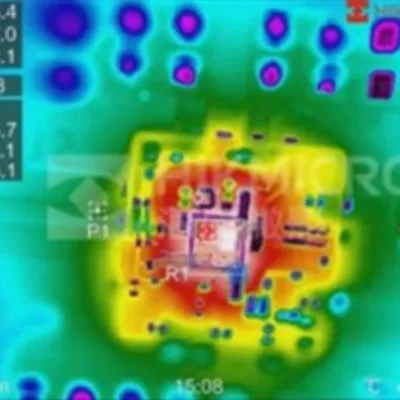
Traditional methods cannot fully measure the temperature distribution within a chip. Thermal imaging technology, however, can provide images of the chip surface temperature distribution, helping to identify potential thermal issues.
[Applications]
1. Non-contact Temperature Measurement: Infrared thermal imagers acquire temperature information by receiving infrared radiation emitted from an object’s surface, providing a basis for chip performance evaluation and fault diagnosis while avoiding mechanical damage to the chip.
2. Inspection of Chips with Small Linewidths: Paired with macro lenses of varying focal lengths, infrared thermal imagers can inspect chips with very small linewidths, which is particularly important for high-end chip R&D.
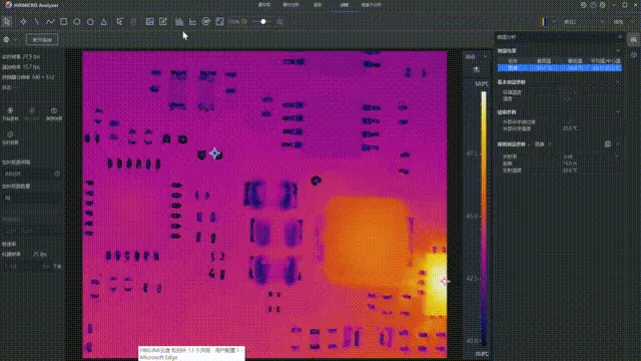
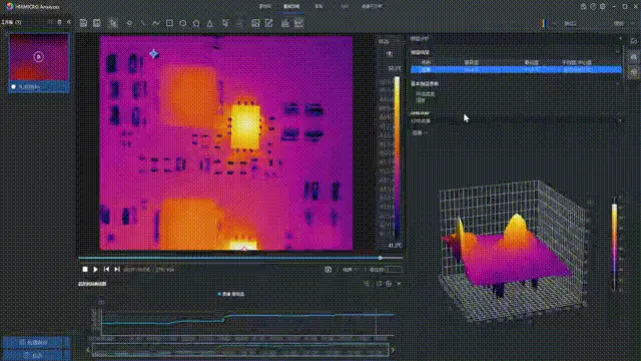
3. Rapid Detection and Real-Time Monitoring: Infrared thermal imagers offer rapid detection speeds, enabling rapid acquisition of chip temperature distribution and real-time monitoring, providing real-time feedback for chip R&D and production.
4. Data Processing and Analysis: Infrared thermal imagers possess powerful data processing and analysis capabilities, enabling in-depth analysis of chip temperature data and optimizing chip design.